
A century after Lithuania appointed its first female judge, women work in law firms, prosecution services and courtrooms. Kateřina Šimáčková, judge of the European Court of Human Rights and keynote speaker at the centenary conference, asks who still decides what the law treats as normal.
In 1926 Elena Jackevičaitė became Lithuania's first female judge. A century later, women work across the legal profession, including in institutions that once offered them few openings. Visibility, however, is not influence. Who reaches the top? Whose lives do legal rules assume? What would change if judges came to the bench with a wider range of experience?
These questions run through Women in Law: Celebrating 100 Years Since the First Female Judge in Lithuania, held at the Seimas on 16 October 2026. Its keynote speaker, Kateřina Šimáčková, has been a judge of the European Court of Human Rights (ECTHR) since 2021 and President of one of its Sections since 2025. Earlier she sat on the Supreme Administrative Court and the Constitutional Court of the Czech Republic. She shared her professional experience and insights on her career, gender and justice, and the next century of women in law.
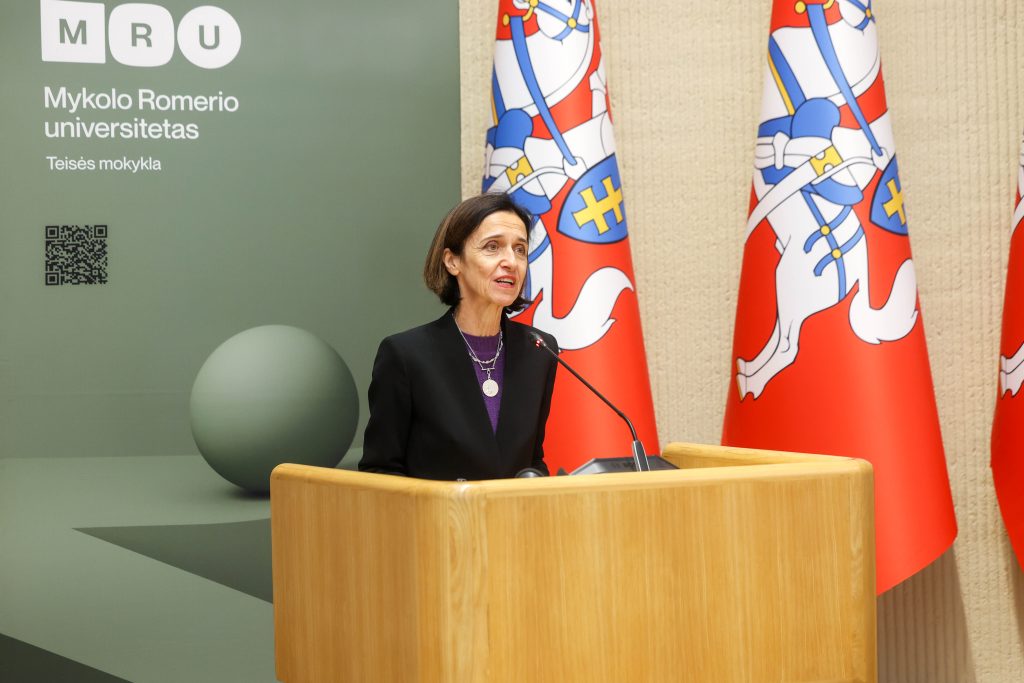
Kateřina Šimáčková, judge of the European Court of Human Rights
The woman who followed the rules
Šimáčková practised law for more than fifteen years and enjoyed helping individual clients and companies. She also kept noticing shortcomings in legislation and judicial practice. She joined the Czech Government's Legislative Council and then the Supreme Administrative Court, where she wanted to remind her colleagues of "the experiences of the people who stand at the gates of justice and knock on its door."
She grew up in a family that told her girls could do anything. Her grandfather, inspired by Czech president Tomáš Garrigue Masaryk, was "a great feminist." As a young woman she saw no difference between her opportunities and those of boys. "If you accept the rules set by men and follow them, you won't encounter direct discrimination," she says. Then she broke through the glass ceiling and became "the token woman." Women who care for relatives, have little support or are less visible did not get that chance, and she regards it as her duty to represent their needs and support them as they grow.
HIStory and HERstory
"We must correct HIStory as the story of men and supplement it with HERstory," Šimáčková says, "that is, a history that also includes the lives and achievements of women."
Šimáčková imagines Elena Jackevičaitė at the conference today, looking at how many women now work in law. The greatest achievement, she believes, would be that Jackevičaitė has become a role model for so many women, and that judging is now a common career for them. What might still disappoint her is the top. Women, Šimáčková says, "carry out the demanding day-to-day work, but it is still men who preside over them or set the standards of case law in the highest courts."
Dovilė Sagatienė, Professor at the MRU Law School and the initiator of the conference, has followed Jackevičaitė's career through the archives, and it was not a quick one. She started at the Kaunas Regional Court in April 1922 as a candidate judge, but only on 1 January 1926 did she become a permanent judge, as Justice of the Peace for the Aleksotas district. The news travelled: reports appeared in neighbouring Estonia and as far away as New Zealand.
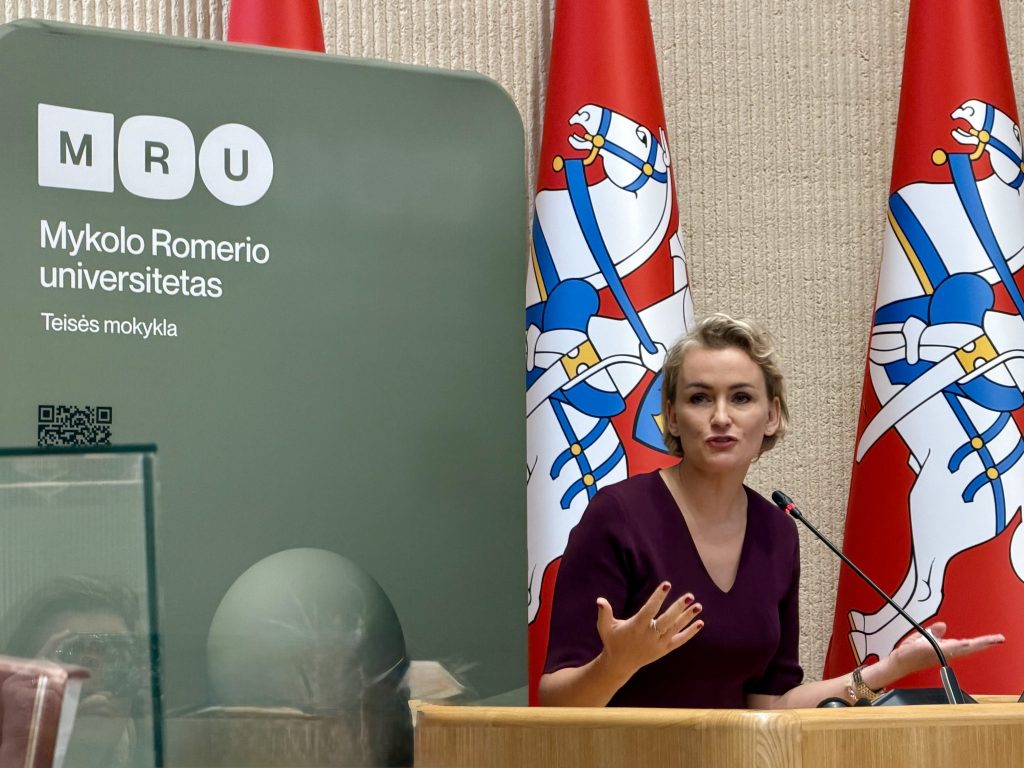
prof. dr. Dovilė Sagatienė
What the numbers say
Šimáčková is one of the editors of two volumes called Men's Law. Are Legal Rules Neutral?, a study of the Czech legal system with contributions from more than 50 authors. The rules, she says, are "simply not gender-neutral." Most were created by privileged men, so a male life, experience and body became the standard. The rules disadvantage women, vulnerable groups and sexual minorities. Women can succeed, but only if they adapt to rules set mainly by men from privileged backgrounds.
Women generally outnumber men among Czech judges, yet they are numerous in family law and scarce in areas seen as more prestigious and complex. They dominate the first instance and make up around 25 per cent of the Supreme Court. When Šimáčková served on the 15-member Constitutional Court, two members were women.
In a related article, Havelková, Kosař and Urbániková interviewed women judges who had made it to the top. Some thought the system fair, because women spend more time with their children and must work diligently and wait for success. The article is called The Art of Waiting Humbly: Women Judges Reflect on Vertical Gender Segregation. For Šimáčková, those conversations were "even sadder."
These figures describe Czech courts.
In interwar Lithuania, prof. dr. D. Sagatienė explains, the law promised more than daily life delivered. The 1918 Provisional Constitution already guaranteed equality before the law irrespective of sex, but social expectations, economic barriers and remnants of discriminatory private law kept limiting women's opportunities. Families that could afford to educate only one child often chose a son, and money for a daughter was saved for a dowry rather than for university. An educated daughter risked being seen as an "educated spinster" whom the family would have to support. In parts of the country, inherited Russian imperial civil law still applied, and under it a married woman could not take a job without her husband's consent. The result shows in the figures: between 1924 and 1940 the Faculty of Law educated 959 lawyers, 896 men and only 63 women.
Would a different bench see differently?
Šimáčková starts with a caution. There are men who are committed feminists, and women who do not understand the needs of women in vulnerable or less privileged situations. Still, at the ECTHR she sees women judges take slightly different views.
In S.A.S. v. France, the Court found no violation of the rights of women affected by France's criminal ban on wearing a full-face veil in public. Two women judges dissented, stressing what the ban meant for the lives of those women. In Jírová and Others v. the Czech Republic, a child in a children's home had lost contact with his former foster parents, the only adults to whom he had been close. The two women on the seven-judge bench gave more weight to the child's possible feelings than to the professional assessment of the home's director.
The Court's understanding of gender-based violence began with domestic violence. In Opuz v. Turkey it stressed the state's positive obligations and found that domestic violence, rooted in social stereotypes, is discriminatory, in breach of the Convention's ban on discrimination. In M.C. v. Bulgaria, a 14-year-old girl said two men had raped her, and the authorities did not prosecute because they considered evidence of physical force insufficient. The Court found, that all forms of non-consensual sexual assault constitute inhuman and degrading treatment, are a serious affront to psychological and physical integrity, human dignity and individual self-determination, while also reinforcing discrimination and gender inequalities
Representation by design, leadership by choice
The ECTHR has more women judges than most European supreme and constitutional courts. Human rights attract women: Šimáčková has met no group of visiting students in which boys were the majority. And states must submit three candidates for each judicial seat, at least one of them from the under-represented sex. Gender balance also counts when judges elect the Court's President, Vice-Presidents and Section Presidents. She is proud to have served under the Court's first female President. In the Czech Republic, the presidents of both her courts were men.
She sees different ways of leading. Some women succeed by being tougher and more competitive and reproduce conventional leadership. Others, having had to work harder to be noticed, understand their colleagues better, though they risk overwork and micromanagement. She tries to practise what she calls "a feminine style of leadership," and mentored younger women lawyers in the Czech Republic. A good leader, she says, asks: "How can I help you to make your work easier?" Humanity and kindness make teams more resilient, and "unhappy and dissatisfied people cannot create a better world."
The next hundred years
Women carry a double burden, Šimáčková says. Besides their jobs, they are the primary carers for children, parents and disabled relatives, and they support their husbands and look after the atmosphere at home. This gives them a unique experience to draw on in decisions, and it holds them back. She asks for a fairer sharing of care within families and more public services for carers.
Two more things hold women back. One is perfectionism: the perfect mother, daughter, wife, boss, friend, beauty, lawyer and citizen. "Sometimes you just have to let things go." The other is that women do not support one another enough. In the Czech Republic mothers can take a very poorly paid three-year parental leave, and a woman who returns to work earlier will meet someone asking whether she is not sorry to be giving up 24/7 time with her child.
Her agenda for the next century: high-quality social services for carers, greater sensitivity towards victims of sexual violence, equal representation in decision-making bodies, equal pay, mother-centred maternity care and genuine equal opportunities for girls everywhere in the world.
A century ago, Elena Jackevičaitė took her seat on the bench. Šimáčková's agenda is about what has to change so that women's experience counts once they sit there.
Text prepared by MRU science communicator Laura Stankūnė
Photos: LR Seimas