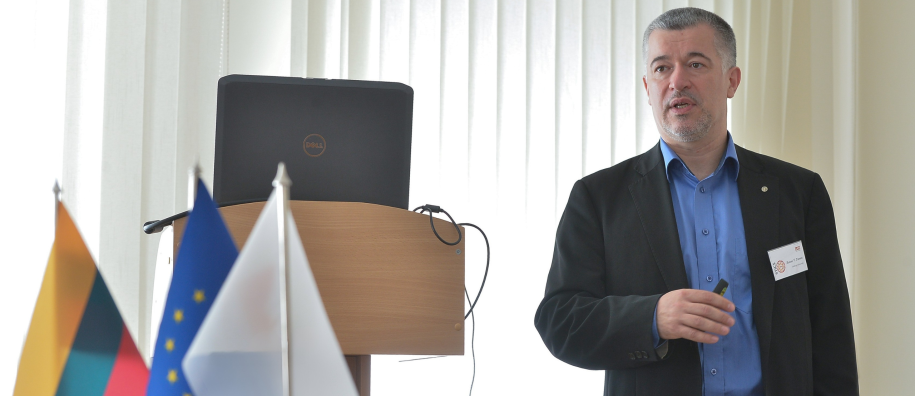
Professor Romeo V. Turcan from Aalborg University Business School (Denmark) will visit Mykolas Romeris University (MRU) in May–June, where he will give a lecture series for the academic community titled “Enhancing Your Pedagogical and Curriculum Design Skills: Problem-Based Learning as an Innovative Methodology in Today’s AI World.”
During his visit, the professor will share his international experience in transforming higher education curricula through the integration of real-world problems, challenges, and insights from beyond academia, alongside advanced pedagogical approaches. A key focus will be on student-centred and self-directed learning approaches that empower students to take ownership of their learning process and develop critical thinking, creativity, reflection, and peer feedback skills.
Both academic and administrative staff are invited to participate. Academic staff will have the opportunity to deepen their knowledge of designing PBL-based study programmes, innovative teaching methods, and assessment approaches. Administrative staff will gain a better understanding of what is required to implement innovative, problem-based higher education in practice, including the institutional and organisational changes involved.
Lecture schedule
- May 27, 15:00–17:00, room I-312
- May 28, 15:00–17:00, room I-312
- June 4, 15:00–17:00, room I-416
- June 5, 15:00–17:00, room I-108
About the professor
Romeo V. Turcan is a professor at Aalborg University Business School, a lifetime member of Clare Hall, University of Cambridge, and a Visiting Professor at the Department of Sociology at the University of Cambridge. He also holds an adjunct professorship at Trinity Business School.
His main research interests include the legitimation of new ideas and theory-building across diverse disciplines and international contexts. He is the founder and coordinator of the interdisciplinary, inter-sectoral, inter-technology, and international Theory Building Research Programme. Since 2012, as principal investigator, he has secured more than EUR 8 million in EU funding and coordinated five EU-funded projects.