The digital games and animation industry today is one of the most dynamic creative fields in the world. It brings together technology, visual arts, storytelling, and interactivity. Professionals frequently move between film and game development, as 3D animation skills have become a universal creative language across borders.
In this global landscape, the partnership between Mykolas Romeris University (MRU) and Dongseo University (DSU) in the Republic of Korea plays a significant role. Together, the universities offer joint double-degree bachelor’s programmes in Game Development and Digital Animation, as well as Digital Media Design. Students spend two years studying in Lithuania and the remaining two years in the Republic of Korea, gaining valuable experience in the international creative industries market.
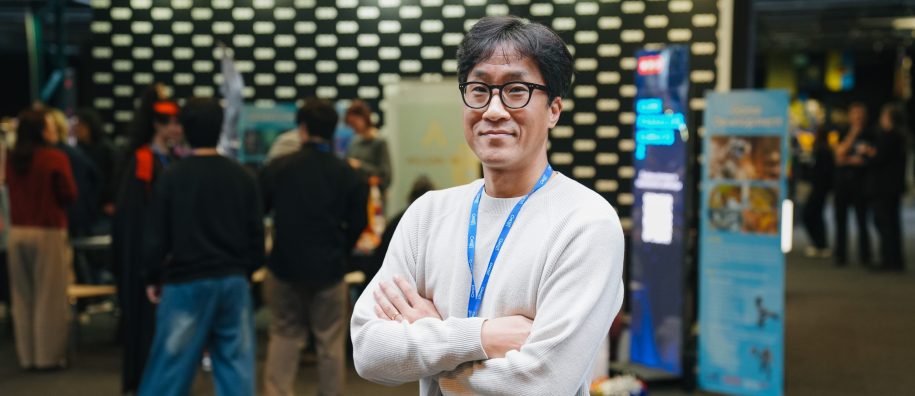
One of the lecturers in these programmes is Professor Do Hoon Kim, who brings extensive international experience to DSU. Before entering academia, he spent many years working in the game and film industries in the United States as a professional 3D animator. Today, he teaches 3D animation to students from various countries, helping them understand how digital worlds, characters, and visual stories are created.
– The Republic of Korea is often regarded as one of the global leaders in the gaming industry. What, in your opinion, contributed most to this success?
– I believe several key factors played a role: a highly developed digital infrastructure, Koreans’ passion for games, and strong support from public institutions. Korea adopted high-speed internet very early—more than 20 years ago. Since then, countless games and new intellectual properties have emerged. So technological foundations, support, and enthusiasm were the three essential pillars of this success.
– How has the game development landscape in Korea changed in recent years? What trends do you find most exciting?
– In recent years, Korean game development has expanded beyond traditional PC and mobile segments toward global, multi-platform projects and production pipelines where artificial intelligence plays a major role. I am especially fascinated by how AI and advanced production tools are transforming the entire game development process.
– What are the main challenges game developers face today in Korea and worldwide?
– The biggest challenge is the extremely rapid advancement of artificial intelligence. Developers must constantly adapt to new engines, new tools, and new AI technologies. This is a global challenge, not just a Korean one.
– In such a fast-changing industry, what qualities or skills do young creators need in order to succeed?
– The most important qualities are adaptability and curiosity. Young creators must remain open to emerging technologies while maintaining strong creative fundamentals—both in game development and animation.
– DSU and MRU run joint programmes in Game Development and Digital Studies. How do you evaluate this cooperation? What benefits does it offer students?
– Joint programmes provide students with a broad, global perspective. They experience different cultural creative traditions, design methodologies, and work environments. This collaboration strengthens their ability to work in multicultural teams—a crucial skill in today’s international industry.
– Do you have experience working with Lithuanian students at DSU? What can you say about them?
– Yes, I currently teach animation to Lithuanian students. I greatly appreciate their artistic style—it is very different from the Korean one and has a unique sense of “exoticism” that we do not often see here. Their models inspire me; sometimes I even find myself thinking that I would like to learn to create in their style. Lithuanian students are talented, creative, and distinguished by their original perspective.
– How do you assess Lithuania’s potential in game development? How could cooperation between Lithuanian and Korean creators evolve in the future?
– Lithuania has strong potential due to its rapidly developing tech sector and vibrant creative community. I believe future cooperation could focus on independent (indie) game projects where creative freedom and experimentation are valued. Combining Korea’s technological expertise with the artistic vision of Lithuanian creators could lead to very interesting results.
– In your view, do Lithuanian and Korean students have the potential to develop innovative projects together?
– Absolutely. We recently held a joint hackathon where Lithuanian and Korean students worked in mixed teams. It was fascinating to see how their different styles blended and resulted in unique solutions. Despite cultural differences, they easily found common ground and generated original ideas.
– What would you say to school pupils or prospective students considering joint studies?
– The most important thing is to stay open to new technologies. Artificial intelligence may seem like a competitor, but it can also become a partner. While some artists still hesitate to use AI, it cannot be ignored—it is the inevitable future of creative industries.
Joint programmes offer the opportunity to explore different cultures, work methods, and the specifics of digital creative industries. It is a unique experience that broadens one’s perspective and helps students appreciate the true value of creative diversity.