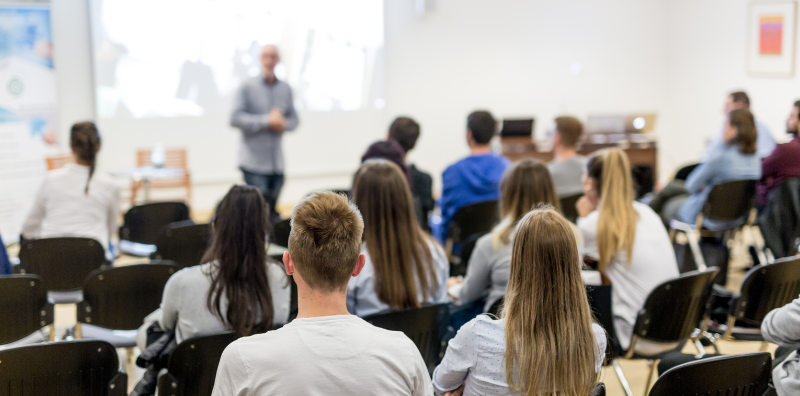
On April 9, 2026, Mykolas Romeris University (MRU) will host an international scientific conference “From Victimisation to Empowerment: Educators’ and Learners’ Discourses of Safety”, which will bring together Lithuanian and foreign scientists, researchers and educational practitioners for a discussion on one of the most relevant topics of today – the safety, well-being and empowerment of students and teachers in the educational environment.
Speakers and the most relevant topics
Plenary sessions will feature presentations by scientists from Poland, Israel, Slovakia, Belgium, and Portugal. They will analyze the intersections of education and security in the context of geopolitical challenges, the professional identity of educators in war zones, the victimization experienced by teachers, and the role of artificial intelligence in creating or weakening security in education. Such an international perspective will allow us to view security issues as a global phenomenon that requires interdisciplinary and international responses.
The latest research and results will be presented at the conference
The latest research findings from Lithuania will be presented at the conference. Thematic sections of the conference will not only discuss theoretical issues, but also present empirical data that provide new insights into the well-being, vulnerability and resilience of children and educators.
One of the sections will present a study which analyzes the links between teacher safety discourse, victimization, critical thinking and psychological well-being and the research on how teachers experience various forms of victimization from students, parents or colleagues, how these experiences affect their professional activities, emotional state and resilience. These topics open up a broader discussion about school safety culture, power relations in the educational community and possible empowerment pathways that help create a supportive and safe educational environment.
The next section will present the results of a study on students’ sense of safety in school today. Researchers, analyzing 2022 OECD PISA data from 80 countries, highlight the profiles of safe and insecure students in academic, social and emotional terms. The results show that fifteen-year-olds who feel safe at school are more engaged in learning, have stronger emotional resilience and a stronger sense of belonging to the community. At the same time, experiences of insecurity are associated with more frequent bullying, emotional stress and withdrawal from the educational process. The study particularly emphasizes the importance of the socio-economic environment and relationships with teachers for children’s well-being and educational success.
The third section of the conference will analyze the development of social skills of children growing up in permanent guardianship (care). Researchers and practitioners will discuss what skills are essential for children living in long-term care, and how educational and care institutions can contribute to strengthening their self-esteem, resilience, relationship building, and safe educational environments. This session focuses on solutions that can increase children's empowerment and social security.
The fourth section will examine the role of non-formal education in ensuring children’s rights in transnational families, when at least one of the parents is abroad for a longer period of time. The speakers will raise questions about the child’s right to participate in non-formal education activities, about the audibility of the child’s voice in making decisions related to education, and about the responsibility of non-formal education leaders in this process. The section will present qualitative research data collected from the perspectives of children, parents, and educators.
The conference organizers emphasize that the international scientific conference is not only a space for the exchange of academic ideas, but also an important platform to publicly raise questions about school safety, children’s rights, educators’ well-being, and the responsibility of education systems. It is expected that the presented research will contribute to data-based solutions that help create safer, more equitable, and more empowering educational environments both in Lithuania and internationally.
About the event
Data: 2026 April 9, 9:00 – 16:30.
Venue: MRU, Ateities st. 20, Vilnius, room I-414 / MS Teams.
The event is organized by the Faculty of Human and Social Studies and the Institute of Educational Sciences and Social Work of Mykolas Romeris University. The conference is being organized within the framework of the implementation of scientific projects funded by the Research Council of Lithuania (LMTLT) under contract No. 989-S-MIP-24-108 (2024–2026), as well as the project “Creation of Centers of Excellence at Mykolas Romeris University” funded by the State, which is implemented under the program “Centers of Excellence Initiative” initiated by the Ministry of Education, Science and Sports of the Republic of Lithuania.