
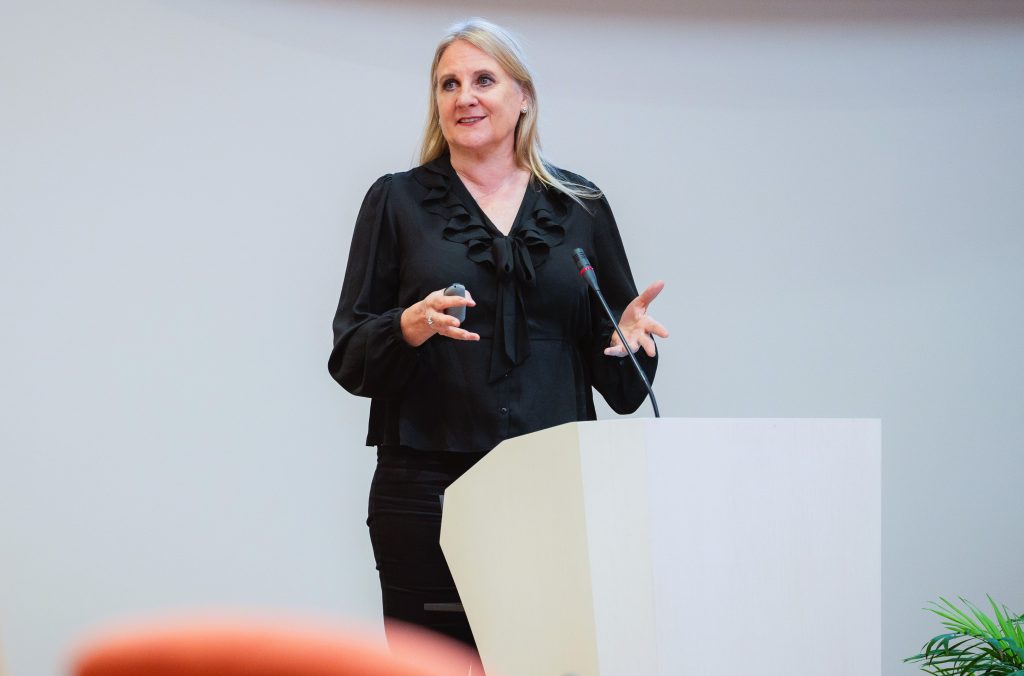
Children with Developmental Language Disorder (DLD) may speak in seemingly correct sentences and yet struggle to understand instructions, follow lessons or express complex ideas. Because their difficulties are often invisible, they can easily be misunderstood. Professor Elin Thordardottir of McGill University*, who recently visited Mykolas Romeris University during MOin – Science and Innovation Week 2026, explored what lies behind this hidden disorder – and what educators can do to make learning more accessible.
Imagine Tomas, a pupil sitting in a classroom. His teacher explains a new concept, gives instructions for an assignment, and asks a question. Tomas listens, perhaps even nods, but does not respond. When he speaks, his sentences sound perfectly ordinary. He makes no obvious grammatical mistakes. Yet, when it comes to understanding the lesson or completing the task, he struggles. His teacher might think he is distracted, not listening carefully enough or simply not trying hard enough. But what if the problem lies elsewhere? Tomas could have Developmental Language Disorder (DLD) – a condition that affects language development and use, often in ways that are difficult to spot.
“DLD is not characterized by unusual overt behaviors but rather by what children do not do. They talk less, they speak in a simpler language but often without mistakes,” explains Professor Elin Thordardottir of McGill University in Canada. This subtlety is precisely what makes DLD so easily overlooked. A child who does not make obvious mistakes may not appear to have language difficulty at all.
When a language difficulty becomes invisible
Dr Aušra Kolbergytė, an MRU researcher leading the NeurodidacticsLT project, initiated Professor Elin Thordardottir's visit to Mykolas Romeris University (MRU). The project team explores how education professionals can develop their competencies through neurodidactic approaches that take into account pupils' individual educational needs as well as differences in how their brains function. The aim is to develop strategies for making schools more inclusive – strategies that can help teachers avoid burnout while enabling pupils to realize their potential and experience success in the learning process. This challenge is becoming increasingly relevant as classrooms include more neurodivergent pupils, including children with autism spectrum conditions and attention deficit hyperactivity disorder (ADHD). Teachers can often feel left on their own to deal with increasingly diverse educational needs. Developmental language disorder adds another, less visible dimension to this challenge.
How DLD can hide at school
According to Professor Elin Thordardottir's presentation, Professionals diagnose DLD when a child shows significantly low language skills without another developmental diagnosis. Research cited in her presentation estimates that around 7 per cent of five-year-old children have DLD. As new cases become apparent during the school years, a typical classroom may include one to four children. Yet many of them may never receive a language-disorder diagnosis. “DLD is often missed or mistaken for other conditions,” Professor Elin Thordardottir notes. “Many children with DLD were initially slow to start talking but not all of them.”
As children grow older, the disorder can become even harder to see. The language demands of school increase. Pupils must understand more complex vocabulary, abstract concepts and figurative language. They also have to navigate increasingly sophisticated texts. They need to follow multi-step instructions, identify key information, understand humor and navigate more complex social situations. A child who once struggled with vocabulary may later appear to have difficulties with reading, learning, organization or social interaction. Professor Elin Thordardottir's presentation highlights an important point: DLD can become even harder to recognize during the school years because its symptoms change over time and because a lack of advanced language skills can look like a lack of other skills. The result can be a child whose actual difficulty is language – but whose behavior is interpreted through an entirely different lens.
What if the solution starts with a few words?
If the problem is often invisible, what can teachers actually do? Professor Elin Thordardottir's answer is strikingly practical. “If you could change just one thing about how teachers work with children with DLD on a daily basis,” she was asked, “what would it be?”
Her answer was simple: teach difficult words before they are needed. “They would teach them difficult words ahead of time so that the children with DLD can better follow what goes on in the classroom instead of struggling to understand new concepts that are being presented.”
The recommendation reflects a broader principle in her presentation: identifying DLD correctly matters because teachers can then strengthen children's language skills and make the language of learning more accessible. In practice, teachers can introduce unfamiliar vocabulary before a lesson. They can explain words and their meanings explicitly and break complex tasks into manageable steps. When necessary, they can also simplify sentence structures and give children enough time to process and respond.
When a child does not understand something, simply repeating the same sentence may not help. Professor Elin Thordardottir recommends rephrasing the sentence. Teachers can use simpler words and sentence structures. They can also explain unfamiliar words by relating them to similar or contrasting concepts. Patience matters, too. Children with DLD need time to process language, and their attempts to communicate should be encouraged. These are not necessarily dramatic interventions. They are small changes in how information is presented – but they can determine whether a child can actually access what is being taught.
Speaking correctly does not mean language comes easily
One of the most important misconceptions about DLD is that a child with a language disorder should necessarily sound as though they are making obvious language mistakes. Professor Elin Thordardottir's research challenges this assumption. Children with DLD do not necessarily produce unusual errors. In many languages, the difficulty becomes visible not through obvious errors, but through the complexity and sophistication of the language children use. As her presentation explains, children with DLD may be quite strategic in the way they use language. They may choose forms that allow them to avoid errors, resulting in language that sounds correct but remains less complex. This can make the difficulty especially hard to notice.
A child may answer a question with a short, simple sentence rather than risk using a more complicated structure. They may know a word but have a less developed understanding of its meaning. They may understand the basic idea of a lesson but struggle when the language becomes more abstract or demanding. That is why Professor Elin Thordardottir argues that assessment cannot focus only on whether children make grammatical mistakes. It also needs to consider the breadth and depth of their vocabulary, their ability to understand and use more complex language and their ability to follow increasingly demanding language tasks.
The consequences can extend far beyond language itself. Oral language is closely connected to reading, and children with DLD may experience difficulties with reading comprehension, writing, mathematics or science. Some children who initially appear to be good readers can fall significantly behind later as the language demands of school increase. This is another reason why correct identification matters: a child who is struggling with reading does not necessarily have dyslexia, just as a child who appears inattentive does not necessarily have an attention disorder. The underlying difficulty may be language.
Bilingualism does not cause DLD
The question becomes even more complex when a child is growing up with two or more languages. Professor Elin Thordardottir's research has examined DLD in bilingual and multilingual children, and her message is clear: bilingualism does not cause DLD, but it does not prevent it either. “DLD has historically been both over- and underdiagnosed in bi/multilingual children,” she explains.
This creates a particular challenge for parents and educators. Learning two languages can result in slower development in one particular language, simply because the child's exposure to each language is divided. DLD can also slow language development – but for a different reason. Distinguishing between the two requires careful assessment rather than assuming that multilingualism is either the explanation or the problem. Professor Elin Thordardottir also challenges another widespread belief in second-language learning. “One idea that seems to die hard is that young children are especially good at learning a second language and that, therefore, no time should be wasted to have them start as early as possible,” she says. “The truth is that older children learn a second language much faster than young children.”
Her point is not that early exposure to another language is harmful. Rather, it challenges the simple assumption that younger children automatically learn a second language more efficiently. For smaller language communities such as Iceland and Lithuania, there is another issue to consider: how children's language abilities are assessed in the first place.
A language needs its own tools
Professor Elin Thordardottir has conducted research involving Icelandic, and she sees important parallels between Iceland and Lithuania as relatively small language communities. “The main challenge is that DLD is identified solely based on language outcomes, therefore appropriate normed language tests need to be available,” she explains.
Lithuania should ideally develop assessment tools specifically for Lithuanian rather than simply translating them from English or another language. “Tests used in Lithuania should preferably be constructed in Lithuanian rather than being translated versions of English or other tests,” she says. “They should focus on language development in Lithuanian and on the language structures that tend to be more challenging for children with DLD who are learning Lithuanian.”
The issue is not only diagnostic accuracy. The environment in which children grow up constantly shapes the language they hear and use. “In a globalized world, English becomes more and more visible through various media,” Professor Elin Thordardottir points out. “Children require consistent language-specific input to master their language.”
Her presentation also highlighted several strengths and challenges in the Lithuanian context. These include a long history of speech and language therapy training, recognition of language disorders in children, access to school-based services and interdisciplinary work. At the same time, the lack of standardized tests and the need for greater public awareness remain important challenges. For a child like Tomas, this may sound like a technical issue. In reality, recognizing the difficulty can make the difference between struggling unnoticed and receiving the right support.
From a bilingual childhood to a career in language
For Professor Elin Thordardottir, language is not only a professional field of research. It has been part of her own life since childhood. “I have always been interested in language, perhaps in part because I was a bilingual child myself,” she says.
She moved to a new country at the age of eight – an experience that has stayed with her. At university, she studied her native language, Icelandic, and considered pursuing a graduate degree in the field. Her eventual career path came almost by accident. She learned about speech-language pathology, a field that brings together linguistics, psychology, neurology, education and other disciplines to understand typical language processes, identify speech and language disorders and support people with communication difficulties. “I didn't have to think twice to choose that field,” she recalls.
Today, her research continues to challenge assumptions about what language difficulties look like, how they interact with bilingualism and cognition, and what schools can do to support children more effectively. Perhaps the most important lesson is also the simplest. When a child struggles to follow a lesson, understand an instruction or express a complex idea, it is tempting to ask whether they are paying attention, trying hard enough or simply not keeping up. But sometimes the question we need to ask first is different: Is the language we are using accessible to this child? For some children, that question may be the beginning of being understood.
* Professor Thordardottir's visit was funded through the project “Establishment of Centres of Excellence at Mykolas Romeris University”, implemented under the Ministry of Education, Science and Sport of the Republic of Lithuania's Centres of Excellence Initiative.
Text prepared by MRU science communicator Laura Stankūnė
Photos: Lukas Kodis